By the time it reaches an exit interview, it has been building for months. EAS gives you a continuous read on how your workforce is actually doing.
Once a year, anonymised, self-reported, and already stale by the time it is presented. It tells you how people felt during the week you asked. It cannot tell you who is running down right now, and it cannot tell you early enough to do anything about it.
Employer mental-health programs return a multiple of their cost, up to $5 for every $1 in the largest UK analysis (Deloitte, 2020).
Mental illness costs Canadian employers $6.3 billion a year in lost productivity, through absence and through people working below baseline (Deloitte Canada, 2019).
Unaddressed, this drives a substantial increase in absenteeism and underperformance.
The evidence base is real. Employer mental-health programs pay back a multiple of what they cost, and measured deployments move stress, sleep, and fatigue within a year.
Sources: Deloitte UK, Mental health and employers (2020) · Deloitte Canada, The ROI in workplace mental health programs (2019) · Chisholm et al., Lancet Psychiatry (2016) · Lowensteyn et al., JOEM (2018). Results vary by organization and program.
This is the question every employee asks and every HR leader has to answer. The boundary is enforced in the database, not left to policy.
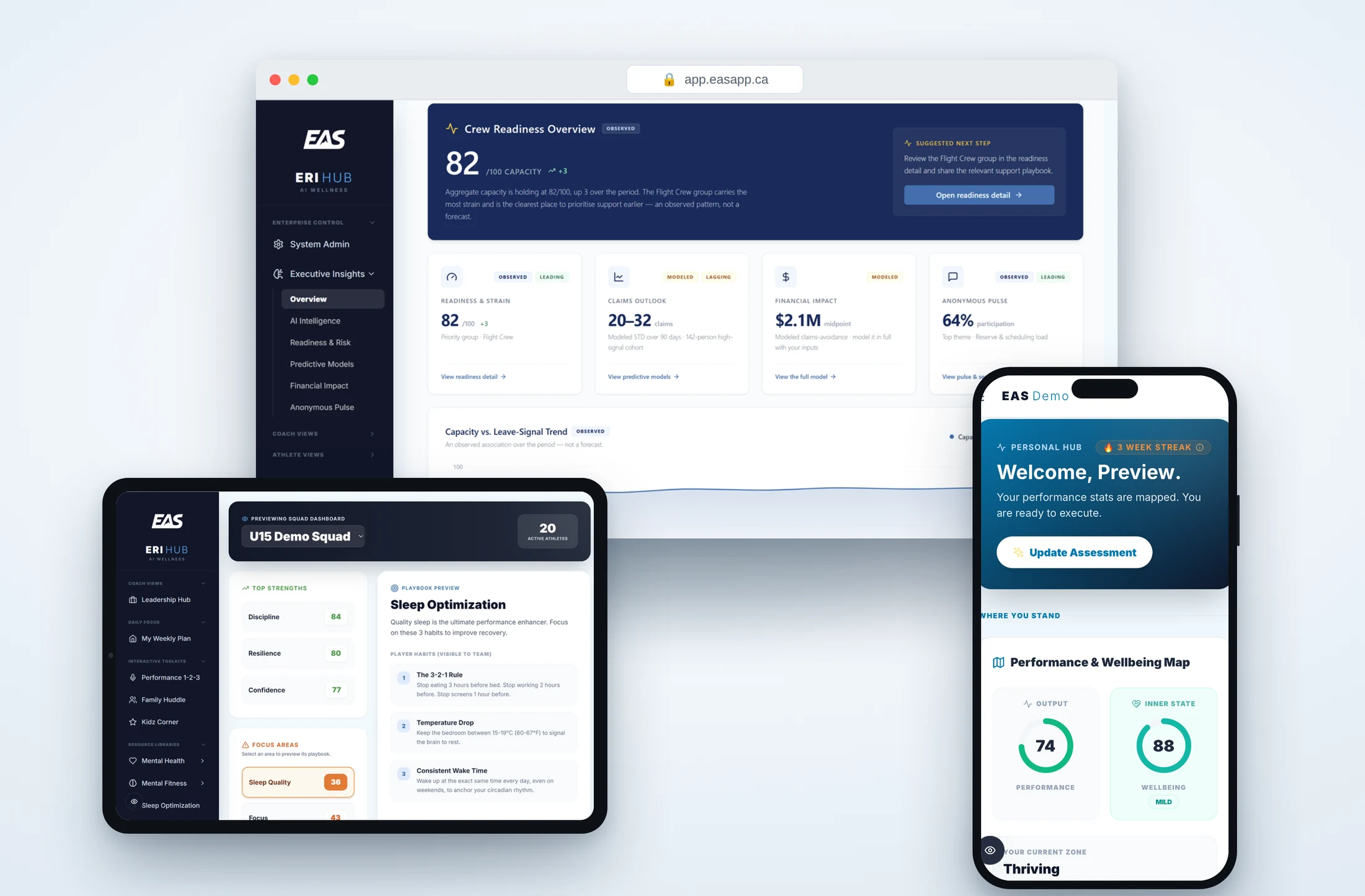
A personal dashboard and content routed from each person's own result. Managers have no read path to an individual's assessment, and family check-ins are readable by that person alone.
Group-level readiness for the people you are responsible for. Enough to act on, never enough to read someone's file.
Aggregate readiness, trend, and cost modelling across the whole population. Ask it questions in plain language.
The clinical screens come from the published literature. The performance and triage questions were developed in-house.
Used as published, so a result means the same thing everywhere it appears.
Light enough to keep doing, on a schedule each organization sets for itself.
EAS is the layer between normal and crisis. It notices early, and it never diagnoses.
An individual's results are readable by that person alone, enforced in the database. Leaders see cohort averages, never computed over groups smaller than five.
HIPAA in the United States, PHIPA and PIPEDA in Canada. Infrastructure runs under a signed Business Associate Agreement on HIPAA-eligible services.
Structured questions are authored by clinicians and fixed, and the assistant answers through retrieval (RAG) to keep answers accurate and grounded in approved content.
Encrypted in transit and at rest · Role-scoped access